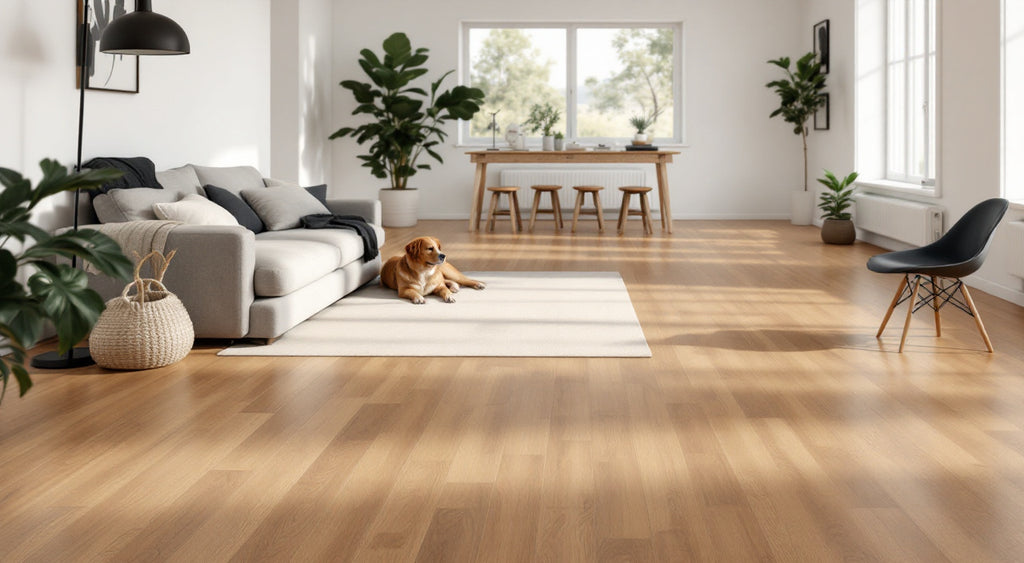
The best vinyl plank flooring for dogs and pets has a matte, textured surface, a mid-tone colour with natural grain variation, a solid wear layer, and tight locking seams. No vinyl is scratch proof, and a good spec sheet will not change that. What a good spec does is make everyday wear harder to see, give your dog steadier footing, and keep accidents on the surface where you can wipe them up.
This guide is about the vinyl specs themselves. If you are still deciding between materials, start with our look at what pet-friendly floors really mean or our guide to flooring for multi-pet households. Already leaning toward real wood? See engineered hardwood for pets. If you have settled on vinyl, this is the checklist.
Which Vinyl Plank Specs Matter Most for Dogs and Pets?
Five specs do most of the work: surface texture, finish sheen, colour and pattern, wear layer thickness, and how well the planks lock together. Each one answers a different pet problem, and none of them answers all of them.
| Spec | What it tells you | What it does not tell you |
|---|---|---|
| Wear layer thickness (mils) | How much clear PVC film sits above the printed image. 12 mil is about 0.3 mm, 20 mil is about 0.5 mm. | Whether claw marks will show, or how hard the surface coating is. |
| Surface texture | How the surface scatters light and how much grip it offers underfoot. | Whether the floor will scratch. |
| Finish sheen | How visible fine marks, hair and paw prints will be. | How easily the surface marks. |
| Colour and pattern | How well the floor disguises hair, dirt and light scratches. | Anything about durability. |
| Locking fit and seams | How tightly planks meet where accidents land. | Whether liquid can never reach a seam. |
Notice the pattern in the right-hand column. Most pet-friendly specs are about visibility and footing, not invincibility. That is the honest way to read them.
Does a Thicker Wear Layer Stop Dog Scratches?
No. A thicker wear layer gives you more clear film above the printed image, which matters over the long life of a floor. It does not mean a dog's claws will leave no mark.
Two separate things sit on top of a vinyl plank. The wear layer is a clear PVC film, and the thickness in mils describes that film. Over it sits a UV-cured coating, which is a different component with its own properties. The mil number says nothing about how hard that coating is. For the full explanation, see our wear layer explainer and our guide to choosing between 12 mil and 20 mil.
Here is the practical takeaway for a pet home. A thicker wear layer is a sensible spec to prefer, because there is more material between the surface and the print. But treat it as one factor, not a guarantee. If a seller tells you a particular mil rating will stand up to a large dog, ask to see the test data behind that claim. Without it, it is a sales line, not a specification.
What Surface Texture and Finish Hide Dog Scratches Best?
A matte or low-sheen finish over a real texture hides fine scratches better than a smooth, glossy surface. This is a visual effect, not a change in how easily the floor marks.
Gloss reflects light in one direction, so every light scuff, paw print and hair catches the eye. Matte scatters the light, so the same wear reads as far less noticeable. Texture adds to this. A surface with a real grain pattern gives the eye no flat, uniform plane to compare a scratch against. Embossed in register texture, where the surface relief lines up with the printed grain, can help disguise fine marks too. Our guides to floor finish and embossed in register texture go deeper on each.
The caution is simple. If a sample feels glassy, flat and shiny under a window, expect it to show every mark once a dog lives on it.

Does Plank Colour and Pattern Matter With Dogs?
Yes, and it matters as much as any spec. The best colour for a pet home is usually a mid-tone with visible grain variation, because it hides hair, dust, paw prints and light scratches at the same time.
Very dark colours make pale hair, dust and any scratch show as a light line. Very light, uniform colours show dirt and paw prints. A mid-tone plank with natural shading and grain variation sits between the two, and a varied pattern gives the eye something to settle on other than a mark. Look at samples in your own room, in both morning and afternoon light, with a dog's usual shedding colour in mind.
Will Your Dog Slip on Vinyl Plank Flooring?
It can, and for older dogs and dogs with joint problems it is worth taking seriously. Veterinary clinics flag smooth, hard floors as a particular concern for senior dogs and large breeds, because weak or arthritic joints make a slip more costly.
A surface with real texture and a low sheen generally gives paws more purchase than a smooth, glossy one. The honest limit is that vinyl texture is shallow, so do not expect it to behave like carpet. Press a hand across the sample, and if you can, see how your own dog moves on it in the store or on a larger sample board.
Where a dog gets up from rest, near doors, and along the main run through the house, a securely backed rug or runner adds footing and also takes the wear instead of the floor. Our guide to rugs on hard floors covers what works. Keeping nails trimmed helps grip as well, and it also reduces the clicking and dragging marks on any hard surface.

Can Pet Accidents Get Through the Seams of Vinyl Plank?
The plank itself will not absorb liquid, but the seams between planks are where a persistent problem can start. A waterproof core means the plank does not swell or warp when wet. It does not make the whole installed floor a sealed tray.
With waterproof flooring, the risk is not the surface. It is liquid that sits long enough, or happens often enough, to travel along a seam toward the subfloor. A tight, well-machined locking profile and a careful installation reduce that risk, but they do not remove it. Our guide to what actually keeps water out explains the difference between a waterproof plank and a water-tight floor.
For a household with a puppy, an elderly dog or a cat with litter habits, three things are worth raising before you buy. Ask how tightly the sample planks close together when you test two of them. Ask the installer how they would handle the perimeter and the seams in your layout, and what the manufacturer recommends. And plan for fast cleanup, because quick wiping is the cheapest protection a seam can get.
Does the Core and Attached Pad Matter for Pets?
Mostly for comfort and sound, not for scratches. The core sits under the wear layer, so it changes how the floor feels and sounds more than how the surface marks.
WPC vinyl flooring has a rigid, durable core with an attached pad, which makes it warmer and quieter underfoot than a harder core like SPC. That matters for a dog that lies on the floor all day and for the click of nails across a room. SPC is denser and harder, which some buyers prefer, but it is colder underfoot. Our comparison of SPC and WPC vinyl covers the trade-off. Neither core makes the surface scratch proof, and an attached pad will not silence long nails.
If scratch visibility is your only worry, it is fair to know that a high-rated laminate generally has a harder surface than vinyl. The trade-off is moisture, which matters when accidents and wet paws are part of daily life. Our comparison of vinyl and laminate lays that out honestly.
What Does "Scratch Proof" Actually Mean on a Vinyl Label?
Usually very little. A label can say scratch resistant, scratch proof or pet proof without any test, standard or number behind it. No vinyl plank is immune to a determined dog with untrimmed nails, and our guide on whether vinyl is really scratch resistant says the same.
Read the claim as marketing unless it names a test and a result. The more useful questions are the ones in the checklist below. And the most reliable protection is not a spec at all. It is trimmed nails and a rug along your dog's regular path.
How Should You Clean Vinyl Plank in a Home With Pets?
Sweep or vacuum often, damp mop with a pH neutral cleaner, and avoid steam mops, which many manufacturers exclude from their warranties. Tracked grit is the main abrasive on the surface, and dry cleaning removes it, so frequent sweeping does more for the floor than heavy mopping.
Use as little water as the job needs, and dry up any puddle instead of leaving it. For any pet odour product, check it against the manufacturer's care instructions first, since some cleaners can leave a film. Our full guide to cleaning vinyl plank covers the routine and what to avoid.
What Should You Ask a Dealer or Installer Before Buying for a Pet Home?
Ask for the facts behind the pet claims, and ask the installer how the floor will be planned around your household. These questions separate a real specification from a slogan:
- What is the wear layer thickness in mils, and what is the surface finish: matte, satin or gloss?
- Is the texture embossed in register, and can I see a full plank in my own light?
- Does the manufacturer publish any scratch or abrasion test data, and what exactly does it measure?
- How tightly do the locking edges close, and what does the installer recommend at the perimeter and the seams?
- Is a floating or glued installation recommended for my room and subfloor?
- What do the care instructions say about steam, cleaners and pet accidents?

Frequently Asked Questions About Vinyl Plank Flooring and Pets
These are the questions pet owners most often ask once they have decided vinyl is the right category.
Is vinyl plank flooring good for dogs?
For many households, yes. It gives you a waterproof surface that is easy to clean and a wide choice of textures and colours that hide everyday wear. The honest caveat is that it can still scratch, so nail care, rugs on main paths and a matte, textured finish do most of the work.
Can dog urine damage vinyl plank flooring?
The plank itself does not absorb urine, so it will not swell the way some other floors do. The risk is urine that sits long enough to travel along a seam toward the subfloor, and odour that follows it. Wipe accidents up quickly, and raise seams and perimeter details with your installer.
Will dog nails scratch vinyl plank flooring?
They can. Long, untrimmed nails are the main cause of visible marks on any hard floor. A matte, textured surface and a mid-tone colour make fine marks much harder to see, but no spec makes a floor scratch proof.
Is a dark or light vinyl plank better for dogs?
Neither extreme. Very dark floors show pale hair, dust and scratches as light lines, and very light floors show dirt and paw prints. A mid-tone with natural grain variation usually hides the most.
Do older dogs need a rug on vinyl plank flooring?
Often, yes. Smooth, hard floors are harder on senior dogs and dogs with joint problems, so a securely backed rug where your dog gets up and along its main route adds footing. Ask your vet if your dog already shows signs of slipping or stiffness.
The Short Version
Choose a matte, textured surface, a mid-tone colour with grain variation, a solid wear layer and a tight locking fit. Treat every pet claim as something to verify, and plan for trimmed nails, a rug on the main path and fast cleanup. That combination matters more than any single number on the box.
To see the full Caledon Floors range, click here.
To find a Caledon Floors dealer near you, click here.